Is Cash Pay Physical Therapy Actually Worth It? A Straight Answer for San Diego Athletes
If you've looked into physical therapy recently, you've probably noticed that some clinics take your insurance and some don't. The ones that don't — cash-pay or "out-of-network" practices — often charge more per session. So the obvious question is: is it worth it?
The answer depends on what you're trying to accomplish. Here's the breakdown.
What You Actually Get With Insurance-Based PT

Insurance-based PT isn't bad. But it's built around a reimbursement model — which means the clinic's workflow is organized around what insurance will pay for, not necessarily what's best for your recovery.
In practice, this often looks like:
15 to 30-minute sessions with a tech or aide doing most of the work
Your DPT checking in briefly and updating notes
Treatment limited to the body part listed on your claim (even if your knee pain comes from your hip)
Discharge driven by session limits, not clinical readiness
For minor, straightforward injuries, that can be fine. For athletes trying to return to sport at full capacity, it frequently isn't.
What the Cash-Pay Model Changes
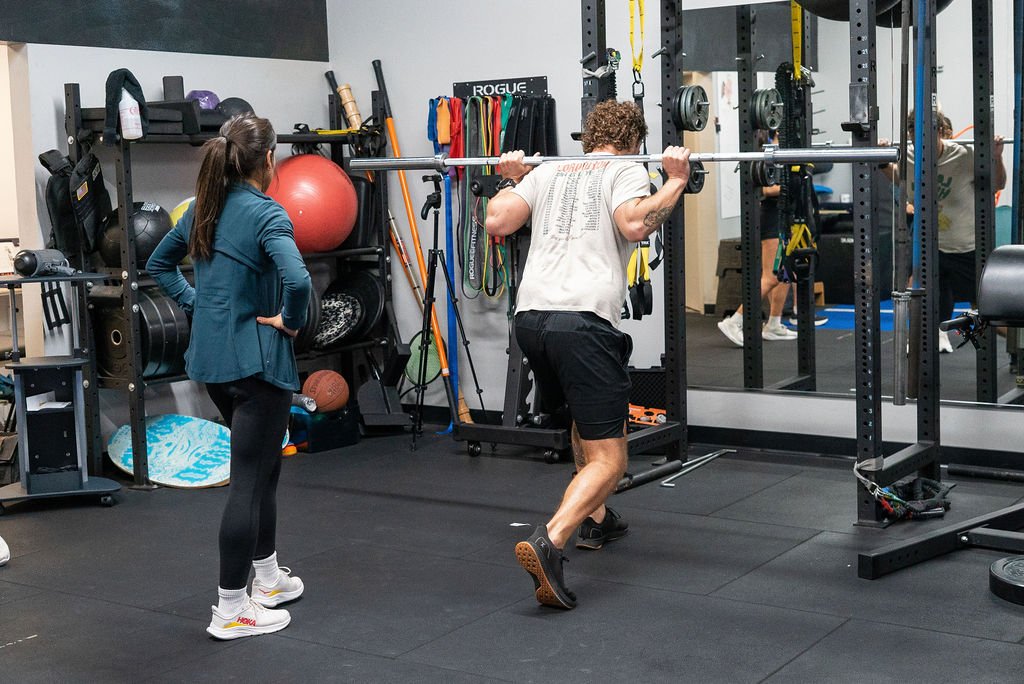
In a cash-pay practice, the financial relationship is between you and your provider — not between your provider and an insurance company. That sounds minor, but the ripple effects are significant.
Your DPT runs the whole session. Not an aide, not a tech. You get 60 minutes of expert attention, hands-on assessment, and programming that evolves based on what they actually observe.

Treatment isn't restricted to one body part. If your running form is loading your knee because your glutes aren't firing, your PT can address the full chain — not just the symptomatic tissue.
The plan is driven by your goals. Cash-pay practices can discharge you when you're ready, not when your plan runs out. They can also see you for performance work, not just pain management.
Is It Actually Cheaper Than Insurance?
Sometimes, yes — especially if you have a high deductible. If your deductible is $3,000 and you haven't met it, you're paying full rate at an in-network clinic anyway, often $150–$250 per session. A cash-pay clinic charging $185–$235 per session may not be dramatically more expensive — and the quality of care per session is significantly higher.
The real math is: how many sessions does it take to get you back to full function? Three high-quality one-on-one sessions often accomplishes more than eight sessions split between a DPT and a tech.
Who Cash Pay PT Is Right For
Cash-pay PT is a strong fit if you're:
An active adult or competitive athlete with a specific performance goal
Working with a high-deductible insurance plan
Frustrated with previous PT that felt generic or impersonal
Recovering from surgery and want dedicated clinical attention, not a protocol
Looking for someone who will actually watch you move, not just give you a sheet of exercises
It's less critical if you have a straightforward acute injury, great insurance coverage, and no performance-related goals.
The Bottom Line
Cash-pay PT costs more per session on paper. But for athletes who are serious about returning to sport, avoiding re-injury, and actually understanding their body — the return on that investment is real.
If you're in San Diego and want to see what a different kind of PT experience looks like, Athletic Edge Physical Therapy offers a free discovery call. No commitment — just a conversation with a Doctor of Physical Therapy about whether it's the right fit.
Schedule your free discovery call →
Athletic Edge Physical Therapy is a cash-pay, one-on-one sports PT clinic in Sorrento Valley, San Diego. Full 60-minute sessions with a DPT — no aides, no handoffs.