Why San Diego Runners Need to Unlock Their Feet
From the soft sands of Mission Beach to the grueling inclines of Torrey Pines, San Diego is a runner’s paradise. But if you’ve been chasing PRs only to be met with nagging plantar fasciitis, bunions, or "heavy" legs, the problem might not be your training volume—it might be your foundation.
Modern running shoes, while cushioned, often feature a narrow "toe box" that squishes our toes together. For a San Diego runner clocking miles on concrete and trail alike, this lack of foot freedom is a recipe for inefficiency. It’s time to talk about the three pillars of foot health: toe spacers, mobility, and strength.
1. The Power of Toe Spacers: Reclaiming Your Natural Blueprint
Think of your foot like a tripod. For maximum stability, you want the "legs" of that tripod—your big toe, pinky toe, and heel—spread wide. Most traditional running shoes taper at the front, forcing the big toe inward (hallux valgus).
Why use toe spacers? (use our discount code AE10)
Improved Balance: Spreading the toes widens your base of support.
Better Alignment: They help realign the bones of the feet, which can alleviate the pressure that causes bunions.
Blood Flow: By uncurling the toes, you allow for better circulation to the intrinsic muscles of the foot.
Pro-Tip for Locals: Wear your spacers while grabbing a post-run acai bowl or walking the dog in Balboa Park. Start with 30 minutes a day and gradually increase as your feet adapt.
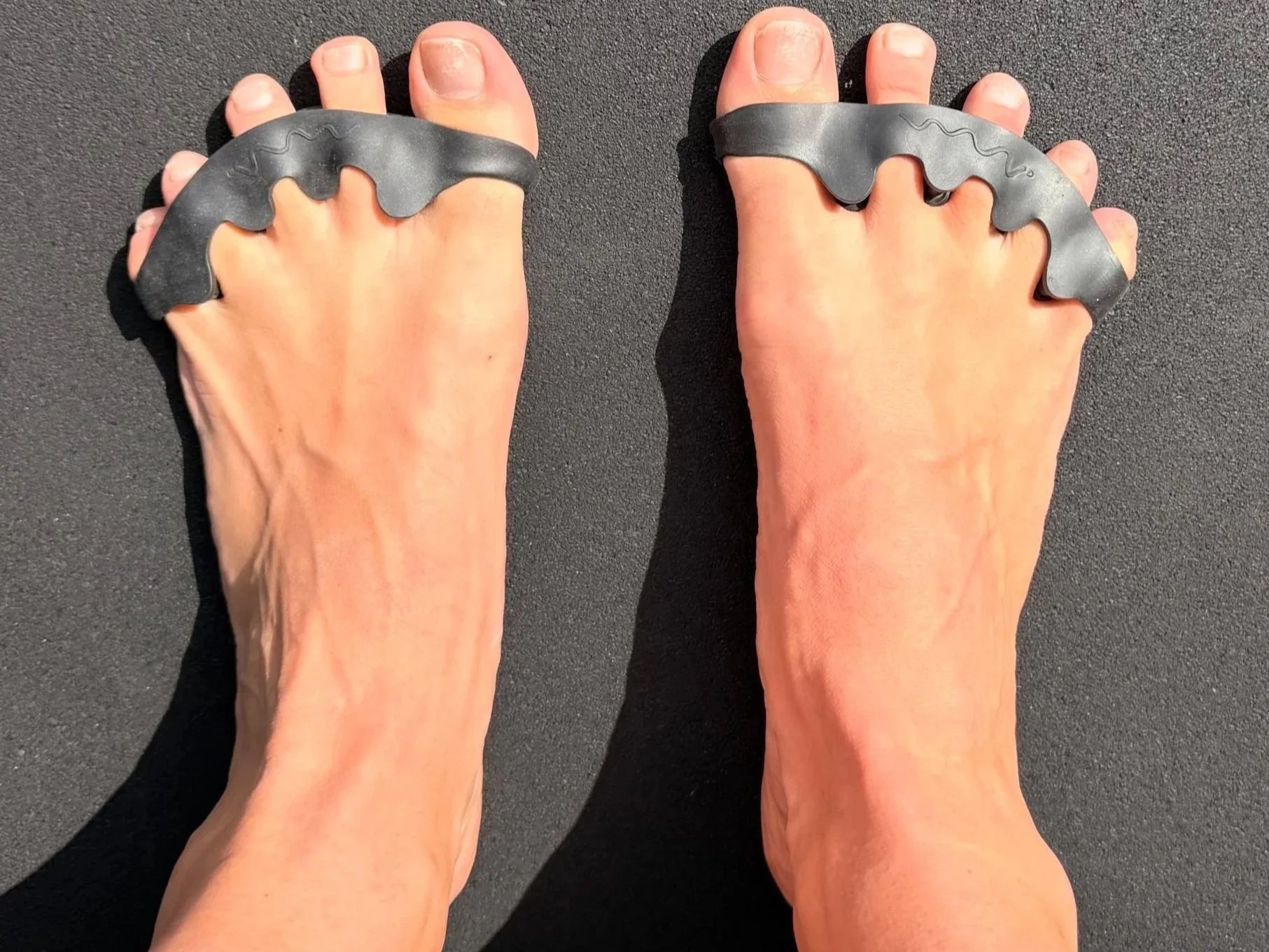
toe spacers for feet
Who Should NOT Jump Straight to Toe Spacers
Toe spacers are a great tool—but they’re not right for everyone right away. If you have any of the following conditions, consult a physical therapist before starting:
Severe bunion deformity (hallux valgus): Aggressive toe spreading may stress already-inflamed joint structures.
Active foot or toe injuries: Stress fractures, acute tendon tears, or open wounds around the toes need to heal first.
Peripheral neuropathy or poor circulation: Altered sensation means you may not notice if the spacers are causing pressure or irritation.
Post-surgical feet: If you’ve had recent foot or ankle surgery, your tissue needs time to recover before adding spacer pressure.
Significant hammertoes or overlapping toes: Forcing a corrective position too quickly can worsen soft-tissue stress.
Bottom line: Start slowly, listen to your feet, and escalate only if you’re pain-free. When in doubt, get a professional assessment first.
2. Foot Mobility: Breaking the "Cast" Effect
Years of wearing stiff shoes can make the 26 bones and 30+ joints in your foot move like a single, solid block. This "casted" foot can't absorb shock properly, sending that impact straight to your shins, knees, and hips.
Try the "Big Toe ISO":
Prehab’s video of big toe lifts
While standing, try to lift only your big toe while keeping the other four pressed into the floor. Then, switch—press the big toe down and lift the others.
The Running Payoff: The big toe is responsible for about 85% of your stability during the "toe-off" phase of your stride. Improving mobility here means a more powerful, efficient push-off with every step.
3. Strengthening the "Foot Core"
We talk about core strength for our abs, but your "foot core" is what maintains your arch. A collapsed arch leads to overpronation, which wastes energy and slows you down on those long stretches of the Silver Strand.
Essential Exercises for San Diego Runners:
Short Foot Exercise/Foot Tripod: Try to "shorten" your foot by pulling the ball of your foot toward your heel without curling your toes.
Towel Crunches: Sit down and use your toes to pull a hand towel toward you on a smooth floor.
Calf Raises (Big Toe Focus): Perform slow calf raises, ensuring you are pushing through the base of the big toe rather than rolling onto the outside of your foot.
How This Makes You a Faster Runner
When your toes can splay and your foot muscles are strong, you tap into "natural suspension." Instead of your joints taking a beating on the pavement, your feet act as springs.
By improving your foot mechanics, you decrease the "Energy Input" required to stabilize yourself, leaving more fuel in the tank for that final kick toward the finish line at the Rock ‘n’ Roll Marathon or your local 5K.
When Foot Pain May Need a PT Evaluation
Not all foot discomfort is “normal adaptation.” Seek a physical therapy evaluation if you experience any of the following:
Pain that persists beyond 2 weeks despite rest and self-care
Sharp, stabbing heel pain with your first steps in the morning (a hallmark of plantar fasciitis)
Swelling, bruising, or visible deformity after a run
Numbness or tingling in the toes or forefoot that does not resolve
Pain that begins to affect your gait—limping, altered stride, or compensating on one side
Symptoms that are getting progressively worse rather than staying stable
Why it matters: Catching issues like stress fractures, posterior tibial tendon dysfunction, or nerve entrapments early can mean the difference between a two-week rest and a season-ending injury. A licensed physical therapist can identify the root cause and build a plan that keeps you on the trails.
Summary: Your Foot Health Checklist
Toe Spacers: Daily (passive mobility ) Realigns toes and widens base
Big Toe Mobility: Before every run; Increases power during push off phase.
Short Foot Drills: 3x Per Week; Strengthens arch & helps prevents injury.
Final Thoughts
San Diego runners are some of the most dedicated in the country. Don't let your gear—or a lack of foot prep—limit your potential. By incorporating toe spacers and targeted foot work, you aren't just preventing injury; you're building a more athletic, responsive, and efficient stride.
Ready to hit the Pacific Beach boardwalk with a new level of power? Start from the ground up.
Schedule a discovery call with us at Athletic Edge Physical Therapy if you’d like to learn more about how we can work together to reduce any pain you have with running and improve overall sports performance.
References & Further Reading
1. Jamíŋ P, et al. (2016). “Intrinsic foot muscle contributions to plantar aponeurosis strain. Journal of Anatomy, 228(1), 68–75. doi.org/10.1111/joa.12386
2. Mickle KJ, et al. (2009). “Toe weakness and deformity increase the risk of falls in older people.” Clinical Biomechanics, 24(10), 787–791. doi.org/10.1016/j.clinbiomech.2009.08.004
Frequently Asked Questions (FAQ)
-
Most people notice improved toe splay and reduced foot fatigue within 2–4 weeks of consistent daily use. Structural changes (e.g., reduced bunion pressure) take longer—typically 3–6 months of dedicated foot work combined with appropriate footwear.
-
Not all toe spacers are designed for in-shoe use. Some low-profile spacers can fit inside wide toe-box shoes during activity, but most are best used for recovery periods. Consult your PT before running with spacers to avoid pressure points or altered gait mechanics.
-
No—they serve different purposes. Orthotics provide external arch support and corrective alignment from beneath the foot. Toe spacers promote intrinsic muscle activation and toe alignment. For many runners, both can be used together under professional guidance.
-
Not exactly. Plantar fasciitis is inflammation of the plantar fascia (the thick band running along the bottom of your foot). Heel spurs are calcium deposits that can form as a result of chronic plantar fascia stress. You can have one without the other, and treatment differs—a PT evaluation is the best way to clarify your diagnosis.
-
Look for shoes with a wider toe box (brands like Altra, Topo, and New Balance wide-fit models are popular choices), minimal heel-to-toe drop if you’re transitioning gradually, and adequate cushioning for hard San Diego surfaces like concrete and packed trail. Avoid going zero-drop too quickly—transition slowly to prevent overloading the Achilles and plantar fascia.